What happened to Billgang, Hoodpay and Sellpass?
- Published
- August 27, 2026
- Updated
- August 29, 2026
Explore with AI
No balance for anyone to freeze
ByteSell never holds your money. Every sale lands in your own Stripe, PayPal or wallet.
Get startedBillgang, Hoodpay, Sellpass, Antistock and Forebit were all run by the same people, and all five stopped working in August 2026. Sellers had spent the previous three weeks saying they could see their balances but could not withdraw them. Then the sites went dark, and every one of the domains started showing the page below.
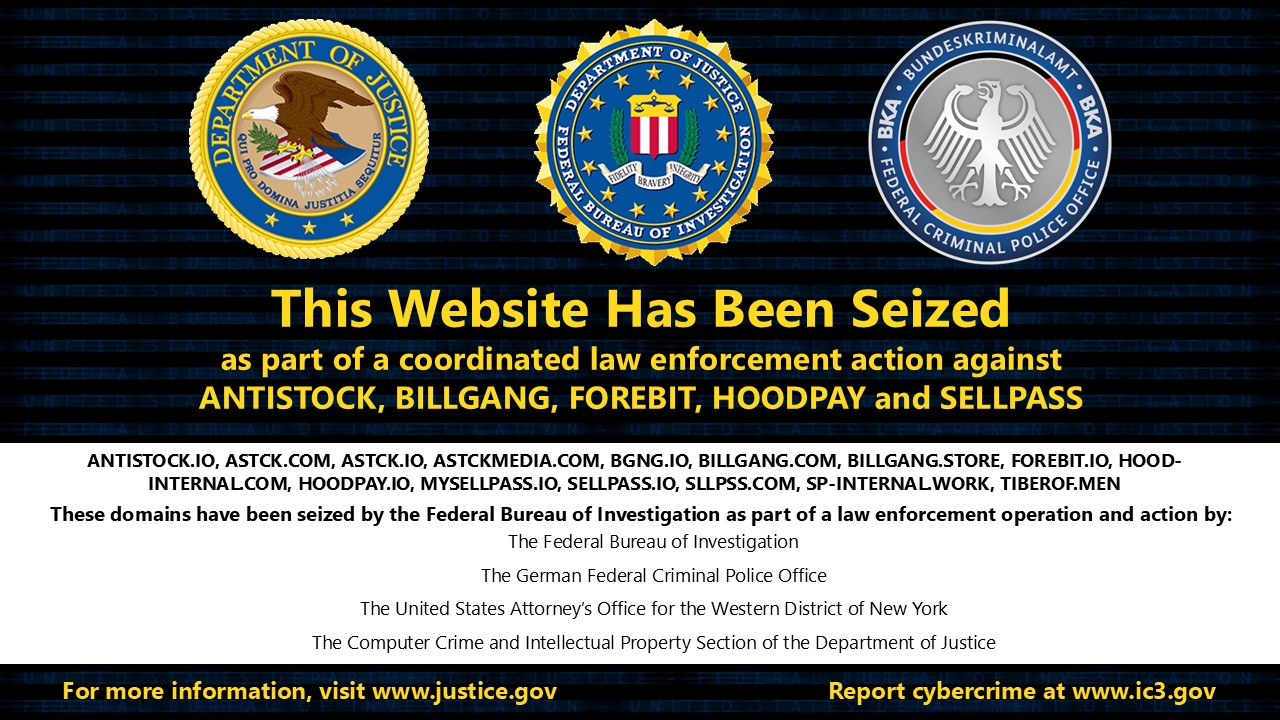
It names four agencies in two countries. None of them has published anything about it, and the public ownership records for those domains do not show a seizure either. The sellers who lost money call it an exit scam, and that reading fits the evidence a good deal better than the banner does.
What the domain records show
When police seize a domain they take it at the registry, which is the public record of who owns a name and where it points. Sellix went through a real seizure in January 2025, so its record is a useful thing to hold these five up against.
| Sellix, really seized | Billgang and the rest | |
|---|---|---|
| Official record points to | FBI nameservers | The owners’ own Cloudflare account |
| Locked by the registry | Yes, three separate locks | No |
| Owner on record | Federal Bureau of Investigation | Sellpass LLC, or a hidden contact |
| Paid up until | February 2034 | September 2026 |
The locks are the part nobody can fake, because only the registry can add them and the owner has no way to take them off. Sellix carries three of them and the FBI is listed as the owner. Billgang, Sellpass and Antistock carry none, their records still point at a Cloudflare account their own operators control, and the seizure page is served from that same account.
The detail that gives it away is smaller than any of that. Whoever runs the account added settings inside it so that a routine lookup answers with ns1.fbi.seized.gov, which is why a quick check appears to confirm the seizure and why the first people to look believed it. The registry entry, which is the one an outside authority would actually have to change, still says Cloudflare.
There is a fairer reading, and it deserves saying. Police sometimes work through a hosting company first and let the paperwork catch up later, which would account for the banner on its own. It does not account for settings that impersonate a government nameserver, and it does not account for letting the registration on billgang.com lapse on September 15, 2026, three weeks after the notice went up.
What sellers reported before the shutdown
Everything in this section comes from one BlackHatWorld thread, opened on 2 August 2026 and titled “We just Lost $75,000+ from Antistock.io/Billgang.com/Sellpass.io or Forebit.io/Hoodpay.io platform exit SCAM”. None of it has been independently confirmed and we have not seen any of the dashboards being described.
The posters describe being pushed onto a new payment system through a popup that gave them no way to decline. Their crypto was moved into fresh wallets, and the keys to those wallets never arrived.
they basically drained all crypto from previous wallets built into the platform and transferred all crypto to a new wallet on their new v2 platform but did not provide encryption key or seed phrase
Four sellers in the thread put a number on what they lost: $75,000, $150,000, $25,000 alongside a further €113,000, and one who says a couple of thousand. That comes to more than $370,000 between them, and it only counts the people who chose to post. These are anonymous accounts with no documentation attached, so treat the figures as claims rather than a total.
A poster in the same thread was the first to notice the FBI nameservers, on 3 August, which is how a forum argument and a DNS record ended up in the same conversation. Nobody has been charged and no court has ruled on any of this, so the operators have not been found to have done anything.
Has any agency confirmed a seizure?
No. The banner credits the FBI, the German Federal Criminal Police Office, the US Attorney’s Office for the Western District of New York and the Justice Department, and not one of the four has published a press release naming these companies. No charging document exists. Neither BleepingComputer nor Krebs on Security has covered it, which is unusual for a case that supposedly took fifteen domains across two countries.
Sellix is the comparison again. That seizure arrived with a named operation, a Europol announcement and press coverage inside the same week, so sellers knew within days who had acted and roughly why. Agencies announce this kind of thing, because the announcement is most of the deterrent.
What to do if you sold on one of these
Assume the storefront is gone for good. Sellix never came back after its seizure and nothing published since August points to a restart here, so the useful question is which of your files, buyer records and order history you already hold a copy of somewhere outside that login.
On money you were owed, nobody can honestly tell you what happens next, because nothing has been published that would let anyone say. Write down what you were owed while you still remember it accurately and keep any screenshots you took. Be wary of anyone offering to recover funds for a fee: those offers turn up within days of something like this, and they go after the people who lost the most.
Your buyers are the part you can still put right. Anyone who paid in the last few days before the sites went dark is holding a download link that no longer works and an email address at a company that will never answer. Reissuing those files from wherever you rebuild is usually what decides between a customer who follows you across and a chargeback you hear about next month.
How to check whether a platform holds your money
One question does most of the work here. Does this platform ever hold my money, and for how long? A platform balance is a claim against a company rather than money in your possession, and claims can be frozen by a court, a payment partner or the company itself. These five checks take an afternoon and they are worth doing before you list anything.
Buy your own product for a dollar
Then open your own Stripe or PayPal dashboard, not the platform’s. If the payment is sitting there, the platform never touched it. If it only shows as a figure you have to request, the platform is holding your money and everything below applies.
Ask support for the seed phrase in writing
If a platform generated a crypto wallet for you, open a ticket and ask for the private key or seed phrase, then keep the reply. A wallet you cannot restore somewhere else is not yours, and this is the exact gap the Billgang sellers fell through.
Read the payout terms before you list, not after
Find the minimum balance, the holding period and how long payouts actually take. Those three numbers decide how much of your money is out of reach on any given day, and they are usually in the help centre rather than on the pricing page.
Withdraw first, then accept any payments change
When a platform makes you move to a new payment system, empty the balance as far as it will let you before you click through. If withdrawals happen to be unavailable during the migration, you have your answer about the migration.
Export your buyers on the first of every month
Products, buyer emails, order history and licence keys, saved somewhere that is not the platform. Put it in the calendar as a recurring task, because the export button is reliably the first thing to stop working.
Plenty of platforms hold balances and pay out reliably for years, and Etsy and Patreon do it because they are the merchant of record and there is no other way for them to work. The point is not that holding money is wrong. It is that you should know which arrangement you are in, because that is what decides what a bad month at the company costs you.